How to Find the Best YouTube Keywords for Your Videos?
how to find the best YouTube keywords for your videos using free tools, search suggestions, and keyword research techniques to improve your video SEO.
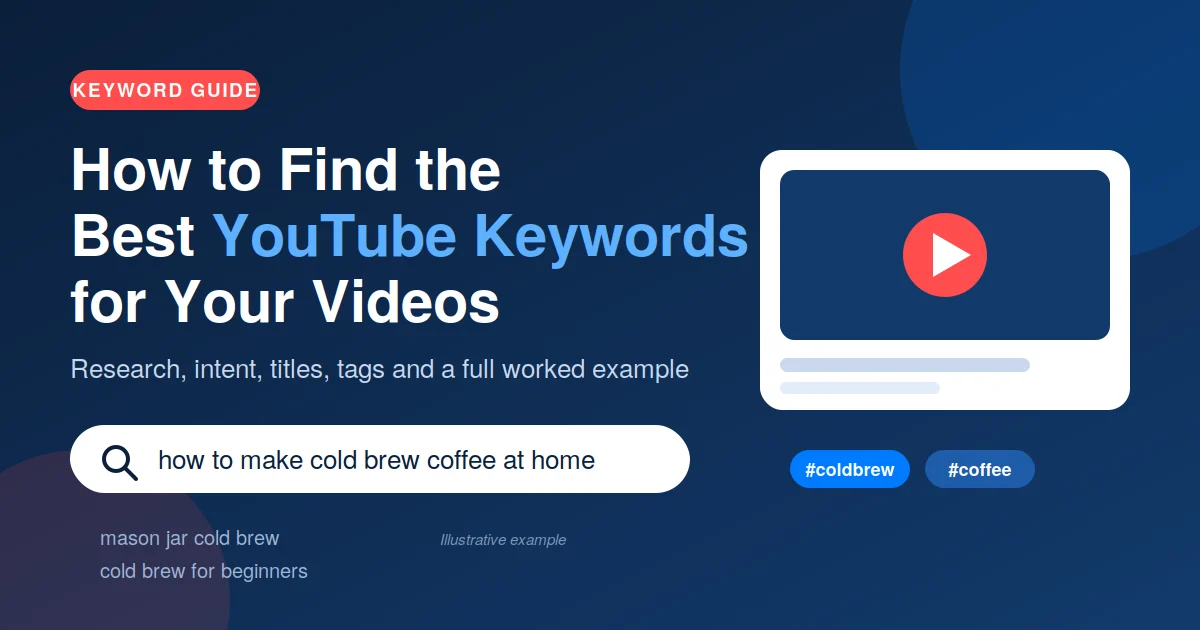
Every video you upload starts with the same quiet problem: somewhere out there, people are looking for exactly what you made, but they type their question into YouTube in their own words, not yours. A cooking channel might title a video "Weeknight Pasta Perfection" while viewers search for "easy pasta dinner for two." Keywords are the bridge between those two phrasings, and finding the right ones is one of the most practical skills a creator can build.
This guide covers the whole process: what keywords are, how to research them, how to judge intent and competition, where to place them, and which mistakes waste the most time. It includes a full worked example you can copy for your own next upload. One note up front: keyword research makes your video's topic clearer to viewers and to YouTube. It does not guarantee views, rankings, subscribers, or income.
What Are YouTube Keywords and Why Are They Important?
A YouTube keyword is a word or phrase that describes what your video is about and that real people type into YouTube's search bar. "How to tie a tie," "beginner guitar chords," and "Pixel 9 camera review" are all keyword phrases. On YouTube, most useful keywords are short phrases rather than single words, because people search in questions and descriptions.
Keywords matter because YouTube has to work out what a video is about before it can show it to anyone. You control several of the clearest signals directly: the title, the description, the thumbnail, and the tags. YouTube also looks at how viewers respond to a video, and it does not publish a full list of signals, so no one can promise that a particular phrase will produce a particular result. What you can do is remove ambiguity. When your wording matches the wording viewers use, the connection between your video and the right search is easier to make.
Search is only one way videos get discovered. People also arrive through suggested videos, the home feed, Shorts, and external links. Keyword research mainly helps the search side, but it has a second benefit that is easy to overlook: it forces you to define your video's focus before you publish. A video with one clear topic is easier to title, easier to describe, and easier for the right viewer to click.
How YouTube Keyword Research Works
Keyword research is a four-stage loop. Treat it as a way to understand your audience, not a hunt for magic words.
- Identify the topic. Describe what the video is genuinely about in one plain sentence. If you cannot, the research will be muddy too.
- Research the search terms. Look at how real viewers phrase the topic. Autocomplete suggestions, titles of existing videos, YouTube Studio's search insights, and comment sections are all good sources.
- Evaluate relevance and intent. For each candidate phrase, ask whether your video truly delivers what that searcher wants. A popular phrase that does not match your content is a trap.
- Select and place. Pick one primary keyword and a few supporting ones, then use them naturally in your title, description, and tags.
Notice that "pick the most searched phrase" is not on the list. Search volume is one input, but relevance and intent come first. A phrase fewer people search, but that perfectly describes your video, will usually serve you better than a bigger phrase you only loosely fit.
How to Find YouTube Keywords for Your Videos
This method works for tutorials, reviews, vlogs, and gaming videos alike. The full worked example later in this guide applies every step to a real video idea.
Step 1: Describe the topic three ways
Say you are making a video about repairing a bicycle flat tire. Write down how you would describe it, how a beginner would describe it, and how a frustrated person at the roadside would describe it. You might get "patch a bicycle inner tube," "fix a bike tire," and "bike tire went flat what do I do." These three versions rarely overlap, and that gap between how creators talk and how viewers talk is exactly what keyword research exists to close.
Step 2: Study what already exists
Search your topic on YouTube and read the first page of results. Note the wording of the titles and the format of the videos: short how-tos, long deep dives, reviews, or compilations. To see how other creators in your niche label similar content, run a couple of public videos through the YouTube Tag Extractor. You paste a video link and it shows the tags the uploader added, which are normally hidden on the watch page. Tags are optional, so some videos will show few or none. Use what you find as vocabulary inspiration, not a list to copy.
Step 3: Expand with modifiers
Take your best phrases and add modifiers such as "for beginners," "without tools," "step by step," "at home," "vs," or "cheap." Each modifier narrows the topic and often reveals a more specific audience. Working from ten to fifteen phrases instead of one makes it much easier to spot angles you would otherwise miss.
Step 4: Match phrases to video types
Different formats lean on different keyword styles:
- Tutorials: "how to" and "step by step" phrasing, plus the specific tool or software name.
- Reviews: the product name plus words like "review," "worth it," or "after 6 months."
- Entertainment and vlogs: the name of the place, game, event, or character, since viewers often search for those directly.
- Educational explainers: the question the viewer is asking, such as "why does the moon change shape."
Step 5: Build a vocabulary map
Make a two-column list: the words you naturally use for your topic, and the words viewers use. Creators often use professional or insider terms ("concentrate," "inner tube," "mise en place") while beginners search with everyday descriptions. When the columns differ, use the viewer's phrase in your title and your own term in the body of the description, where you can explain it. This small habit often improves a video's clarity more than any tool does.
How to Use YouTube Search Suggestions for Keyword Ideas
The YouTube search bar is one of the best free research tools available, because its suggestions are based on what people actually search for. When you start typing, YouTube completes the phrase with likely endings, which gives you a direct window into real search behavior.
How to do it well
- Open YouTube in a private or logged-out window if you can. Suggestions can be influenced by your own watch history, and you want a more neutral view.
- Type your core topic, such as "sourdough bread," and write down every suggestion that appears.
- Add a space and each letter of the alphabet in turn ("sourdough bread a," "sourdough bread b") to uncover more completions.
- Try question words: "how," "why," "can," "what is."
- Record the exact wording. Small differences, such as "at home" versus "for beginners," point to different audiences.
Each suggestion hints at a distinct viewer need. "Sourdough starter not rising" is a troubleshooting need. "Sourdough bread for beginners" is an entry-level learning need. These can become separate videos, each with its own primary keyword.
Use YouTube's own Research tab
If you have a YouTube channel, YouTube Studio may offer a Research tab inside Analytics. According to YouTube Help, you enter a search term and it shows top related searches from the last 28 days, made by viewers across YouTube and not only your own audience. Each term carries a search volume rank of low, medium, or high, and you can save terms to review later. YouTube notes that if no results appear, there is not enough data to estimate interest. Availability and wording can vary by account and region, so check what your own Studio shows.
How to evaluate a suggestion
Not every suggestion deserves a video. Ask three questions. Can you genuinely cover it well? Does the phrase suggest one clear intent? And when you search it, do the top results look like what you plan to make? If the results are all ten-hour compilations and you are planning a five-minute tutorial, viewer expectations may not match your format.
How to Find Low-Competition YouTube Keywords
Broad phrases like "recipes" or "gaming" are crowded with established channels. A newer channel usually has a better chance of connecting with viewers by being more specific, without chasing phrases nobody searches.
Use long-tail phrases
A long-tail keyword is a longer, more specific phrase, usually three or more words. "Vegetarian meal prep for a busy week" is more specific than "meal prep," and the person typing it knows what they want. Specific phrases tend to face fewer competing videos, and the viewers who find yours are more likely to be a good fit.
Audit the competition in five minutes
Search your phrase and look at the first page of results with these questions in mind:
- Who is ranking? If the results are dominated by very large channels with polished productions, a smaller creator may find it harder to stand out for that exact phrase.
- How old are the videos? Older results on a topic that has changed, such as software or a product, may signal room for an up-to-date version.
- How well do they answer the query? If existing videos are vague, outdated, or only partly address the question, you may be able to do it better.
- How are they performing? Paste a few result links into the YouTube Video Statistics tool to see public figures such as views, likes, and comments alongside the publication date. Compare videos of a similar age, and note the date you checked, since numbers change.
Be careful with one trap: "low competition" and "no demand" can look identical. A phrase with few videos may simply be a phrase nobody searches. Cross-check with autocomplete or the Research tab. If YouTube suggests the phrase as you type, someone is searching for it.
Set realistic expectations
A less crowded phrase improves your odds of being relevant to a specific viewer. It does not guarantee a ranking. Video quality, viewer response, your channel's history, and many other factors are involved, and no one outside YouTube knows the full picture.
How to Analyze Search Intent Before Choosing a Keyword
Search intent is the reason behind a search. Two people can type similar words and want completely different things, and matching your video to the intent often decides whether a phrase works for you.
Common types of intent on YouTube
- Informational: the viewer wants to understand something, such as "what is inflation." These reward clear explanations.
- Instructional: the viewer wants to do something, such as "how to change a car battery." These reward step-by-step clarity and good pacing.
- Troubleshooting: the viewer has a problem right now, such as "sourdough starter not rising." These reward getting to the fix quickly.
- Comparison and evaluation: the viewer is deciding between options, such as "iPhone vs Android for photography." These reward honest, specific assessments.
- Entertainment: the viewer wants to be amused or absorbed. These reward personality, editing, and story over information density.
- Navigational: the viewer is looking for a specific channel, creator, or series.
How to read the intent
Search the phrase and look at the results. If they are mostly short, practical demonstrations, the intent is instructional. If they are lists and comparisons, viewers are deciding. If they are long, personality-led videos, the intent leans toward entertainment. Your video should look like it belongs in that set of results. A ten-minute opinion essay for a phrase where everyone wants a 90-second demonstration is a mismatch, however well it is made.
Intent also shapes how you open the video. If the searcher wants a quick fix, give the answer early instead of burying it behind a long introduction.
How to Choose the Best Primary and Secondary Keywords
Once you have a pile of candidates, narrow them down. The simplest framework is one primary keyword and two to four secondary keywords.
The primary keyword
This is the main phrase that describes your video. It should accurately describe your content, reflect a clear search intent, and be specific enough to be useful. For a puncture repair video, "bike" is too broad, while "fix a flat bike tire at home" is specific and clearly matches the content.
The secondary keywords
These are related phrases that support the primary one: variations, related questions, and context. For the bike video they might be "patch an inner tube," "bicycle puncture repair," and "tire levers for beginners." They appear naturally as you describe the steps and help cover the different words viewers use.
A full worked example: from idea to final metadata
The example below walks through the complete process for one video. The candidate phrases are illustrations of what to test, not measured search data. Run each step yourself, because suggestions and results differ by country, language, and time.
The video: a beginner tutorial on making cold brew coffee at home using a mason jar and no special equipment.
Step 1, one-sentence summary. "This video shows beginners how to make cold brew coffee at home in a mason jar." Everything that follows must fit that sentence.
Step 2, three vocabularies.
- Creator wording: "cold brew concentrate method."
- Beginner wording: "how to make cold brew at home."
- Frustrated wording: "why is my cold brew bitter." This is a troubleshooting intent, so it belongs to a different video.
Step 3, autocomplete. Type "cold brew" into YouTube, then add each letter and the question words "how" and "why." Write down every completion you actually see. Suppose the list includes phrases about making it at home, using a jar, and doing it for beginners. Those are the phrases to evaluate.
Step 4, results audit. Search each candidate and record what the first page looks like. Then fill in a table like this one:
| Candidate phrase | Intent seen in results | Fits my video? | Decision |
|---|---|---|---|
| how to make cold brew coffee at home | Instructional, short demonstrations | Yes, exactly | Primary |
| mason jar cold brew | Instructional, equipment-specific | Yes, it is my method | Secondary |
| cold brew for beginners | Instructional, entry level | Yes | Secondary |
| cold brew vs iced coffee | Comparison | No, different format | Save for a future video |
| best cold brew makers | Product roundup | No, I use no special equipment | Reject |
| why is my cold brew bitter | Troubleshooting | Partly | Separate video |
The rejected rows are not wasted. They become your next uploads, each with its own primary keyword.
Step 5, demand check. If your Studio has the Research tab, search "cold brew" and see which related searches appear and how YouTube ranks their volume. Treat the rank as a rough guide only.
Step 6, vocabulary check on public videos. Run two or three public cold brew videos through the tag extractor and note recurring wording, such as how people refer to the jar or the steeping time. Use only terms that honestly describe your video.
Step 7, write the metadata.
- Title: "How to Make Cold Brew Coffee at Home in a Mason Jar (No Special Equipment)." The primary keyword leads, the method and the benefit follow, and it reads like a sentence.
- Description opening: "In this video, you will learn how to make cold brew coffee at home using a mason jar and ingredients you already have. It is a beginner-friendly method that needs no special equipment." This puts the primary and two secondary phrases into plain sentences.
- Tags: the primary phrase, "mason jar cold brew," "cold brew for beginners," and any spelling variants viewers might use.
- Hashtags: two or three, such as #coldbrew and #coffee, placed in the description.
Step 8, log it. Add a row to your research file with the video topic, primary and secondary keywords, intent, and a note on what the top results looked like. A few weeks after publishing, compare the video's search-related data in YouTube Studio with your notes and adjust your next upload accordingly.
Avoid keyword stuffing
Stuffing means forcing a phrase in repeatedly where it does not read naturally: "cold brew coffee, cold brew recipe, cold brew at home, easy cold brew." It makes titles and descriptions harder to read and does not help viewers. Read your text aloud. If it sounds like a list of search terms instead of a sentence a person would say, rewrite it.
How to Use YouTube Keywords in Your Video Titles
The title is the most visible piece of metadata. It has two jobs that sometimes pull in different directions: tell YouTube and viewers what the video is about, and give a person a reason to click.
Principles for strong titles
- Lead with the topic when it makes sense. Long titles can be cut off in search results and on mobile, so the primary keyword near the start keeps the meaning visible. It does not have to be the first word if that makes the title awkward.
- Keep it readable. "How to Fix a Flat Bike Tire in 5 Minutes" reads naturally and contains the keyword. "Bike Tire Fix Flat Repair Bicycle Puncture" does not.
- Add a reason to click. A specific benefit, a number, a time frame, or a distinctive angle gives the viewer something concrete.
- Be accurate. If the video does not deliver what the title promises, viewers leave quickly, which hurts you more than a modest title would have.
- Match the thumbnail. The title and thumbnail work as a pair and should tell the same story.
Avoid misleading clickbait
There is a difference between curiosity and deception. "I Tried Living on $10 a Day in Lisbon" is a hook the video can honestly deliver on. A title that implies a shocking event that never happens does not. Beyond annoying viewers, misleading metadata can conflict with YouTube's spam, deceptive practices, and scams policies. Honest, specific titles build trust over time.
To compare phrasings before you commit, the YouTube Title Generator creates title ideas from a keyword or topic, and it includes a country selector. Treat the output as raw material to rewrite in your own voice. To study how others in your niche word theirs, the YouTube Title Extractor retrieves the title of an existing public video from its link.
How to Optimize YouTube Descriptions With Relevant Keywords
The description gives YouTube extra context about the video and gives viewers a reason to stay and explore. It is also where you can use your primary and secondary keywords in full sentences.
The opening lines
Only the first couple of lines are visible before a viewer expands the description, so make them count. Summarize what the video covers and include your primary keyword where it fits naturally. For example: "In this video, you will learn how to fix a flat bike tire at home using only a patch kit and a pair of tire levers." That sentence is clear to a person and informative to YouTube.
Add real context
After the opening, add a short paragraph or two on what the video covers, who it is for, and the key points. This is the right place for secondary keywords and for the viewer's vocabulary alongside your own terms. Write what you would tell a friend who asked what the video was about.
Useful extras
- Timestamps: for longer videos, chapters help viewers navigate. They need to start at 0:00 and follow YouTube's formatting rules, and each label should describe its section in plain language.
- Relevant links: link to related videos, a playlist, your website, or resources mentioned in the video.
- Social and contact details: keep these short and at the end so they do not crowd out useful content.
The YouTube Description Generator can help when you are staring at a blank box. It is organized around sections such as a video overview, chapters and timeline, channel introduction, related videos, and contact links. Treat its output as a draft: check every line against your actual video, and add the details only you know.
Do not repeat yourself
Repeating the same keyword ten times does not make a description more helpful. Once or twice in natural context is plenty. Spend the space on information that helps the viewer.
How to Use YouTube Tags and Hashtags Effectively
Tags and hashtags are often confused, but they work differently and carry different weight.
Tags
Tags are keywords you add in the video's details in YouTube Studio. Viewers do not see them on the watch page. According to YouTube Help on adding tags, your title, thumbnail, and description are more important pieces of metadata for discovery, and adding excessive tags to a video description is against YouTube's spam policies. Do not spend an hour agonizing over tags.
A sensible approach is a modest set of accurate tags: your primary keyword, a few close variations, and common misspellings of a name or term in your video. Filling the field with unrelated terms does not help. The YouTube Tag Generator can suggest tag ideas from a keyword. It supports many languages, which is useful if your audience searches in a language other than English. Prune the list down to terms that honestly describe your video.
Hashtags
Hashtags are written with a # symbol in the title or description. As YouTube Help on hashtags explains, they work like clickable links that lead to a results page of other videos using the same hashtag, and a few can appear above the video title. They work more like topical labels for browsing than ranking levers. Use a small number of relevant ones, because YouTube may ignore the hashtags on a video if you add too many, and hashtags that break its policies can lead to removal or age restriction.
To see which hashtags other public videos use, the YouTube Hashtag Extractor pulls them from a video's title and description. The YouTube Hashtag Generator drafts suggestions from your topic.
Tags versus hashtags at a glance
- Where they live: tags sit in a hidden details field in YouTube Studio; hashtags are typed in the title or description.
- Who sees them: tags are not shown on the watch page; hashtags are visible and clickable.
- How much they matter: both play a smaller role than your title, thumbnail, and the video itself.
How to Find YouTube Keywords Using Free Keyword Research Tools
Free tools will not replace your judgment, but they save time and keep your research organized. They work from public information and offer suggestions, not guarantees.
What each kind of tool is good for
- Generators create starting lists from a topic, so you do not have to type every variation by hand. They suit videos you have not published yet.
- Extractors show the tags, titles, descriptions, or hashtags already attached to a public video, which helps you understand the vocabulary in your niche.
- Statistics and trend pages give context about how similar content is performing, but they do not tell you which keyword to use.
A research routine using YTLargeTools
- Run two or three relevant public videos through the tag extractor to see how others describe the topic. Use the title extractor on the same videos to compare headline wording.
- Enter your own topic into the tag generator and keep only suggestions that truly describe your video.
- Check public numbers on a competing video with the video statistics tool, comparing videos of a similar age.
- If you want to see what is currently popular, open the YouTube Trend of the Week page. It shows trending videos with language and country filters. Remember that it shows videos, not keywords, so use it for topic and format ideas and then research the actual search phrases separately.
None of these tools can tell you which keyword is certain to succeed. Always compare what they show against your own judgment and the search results you see on YouTube itself.
Keep your own research file
Whatever you use, keep a simple spreadsheet with columns for the video topic, primary keyword, secondary keywords, the intent you identified, a note on what the top results looked like, and the publish date. After a few uploads, patterns emerge. In YouTube Studio Analytics you can then review how viewers found each video; YouTube notes that some data, such as traffic sources, may be limited, so use what is available as directional rather than exact.
Common YouTube Keyword Research Mistakes to Avoid
Targeting keywords unrelated to the video
Adding a trending phrase that has nothing to do with your content might get a few clicks, but viewers leave quickly, and that signals a mismatch. Only target what your video actually covers.
Choosing keywords based only on search volume
A high-volume phrase may be extremely competitive or may not match your video's angle. Weigh volume alongside relevance, intent, and how realistic it is for your channel.
Ignoring search intent
If viewers searching a phrase want a quick tutorial and you deliver a long story, they will leave no matter how well you optimized.
Using overly broad keywords
Phrases like "music" or "fitness" put you up against enormous numbers of videos and attract an unfocused audience. Narrow down with a specific angle, audience, or problem.
Stuffing keywords into titles and descriptions
Repeating the same phrase makes your metadata look spammy to people and does not help your video. Write naturally.
Copying competitors without understanding their audience
Looking at what competitors do is smart. Copying their titles and tags wholesale is not, because their audience, channel size, and format may be completely different from yours. Learn their vocabulary, then make your own choices.
Treating research as a one-time task
Search behavior changes, especially for products, software, and news. Revisit your research file periodically and update older videos when the wording around a topic has shifted.
Expecting keyword research alone to guarantee results
Keywords are one piece of a bigger picture. Content quality, thumbnails, viewer retention, and consistency all play roles. Good keyword research makes a video easier to find and understand. It cannot make an uninteresting video successful.
Frequently Asked Questions About YouTube Keyword Research
1. What are the best keywords for YouTube videos?
The best keywords accurately describe your video, match what a real viewer is searching for, and are specific enough that your video can reasonably compete. There is no universal "best" list. Start with relevance and intent, then use volume and competition as secondary checks.
2. How do I find keywords for my YouTube channel?
Begin with the main topics your channel covers and the questions your audience asks. Use YouTube's search suggestions, study the titles and tags of videos in your niche, check the Research tab in YouTube Studio if you have it, and read comments for the wording viewers use. Group what you find into themes, and you will have a long list of video ideas, each with its own keyword.
3. Are YouTube keywords still important in 2026?
Yes, but their role is clarity, not trickery. YouTube relies on many signals, including how viewers interact with a video, so keywords alone decide nothing. They still help YouTube and viewers understand what a video is about, especially in search. Treat them as one part of good video packaging alongside a strong title, thumbnail, and content.
4. How many keywords should I use in a YouTube video?
There is no magic number. A practical approach is one primary keyword and a handful of related secondary phrases that you can use naturally in your title and description. More is not better if it leads to stuffing.
5. Do YouTube tags help videos rank?
Their effect is limited. YouTube Help says the title, thumbnail, and description are more important for discovery. It is fine to add a few accurate tags, but they are not worth heavy effort.
6. Can I find YouTube keywords for free?
Yes. YouTube's own search suggestions and the Research tab in YouTube Studio (where available) are free, and so is browsing top results in your niche. Free tools such as the tag generator and tag extractor can add extra ideas. Combined with YouTube Studio's analytics for your own channel, you can build a solid research process without paying for anything.
7. What is the difference between YouTube keywords and tags?
Keywords are the phrases people search for and that describe your video's topic. You use them across your title, description, and content. Tags are one specific metadata field in YouTube Studio where you can list terms related to your video. A keyword is a concept you research; a tag is one place you may record it.
8. Where can I see what viewers search for on YouTube?
Start with autocomplete in the YouTube search bar. If your account has it, the Research tab in YouTube Studio Analytics shows related searches and a low, medium, or high volume rank, based on the last 28 days. Public tools can show how existing videos are labeled, but they cannot show private search data.
Conclusion
Finding good YouTube keywords is less about secret formulas and more about listening carefully to how your audience searches. Start with an honest description of your video, explore how viewers phrase the topic, check the intent behind each phrase, and choose a primary keyword that truly fits. Then use it naturally in a clear title and a helpful description, keep tags and hashtags in perspective, and avoid the temptation to stuff or mislead.
Keyword research will not guarantee views, but it will make each video clearer, better targeted, and easier for the right viewers to find. When you are ready to try it, enter your next video idea into the YTLargeTools tag generator and see which suggestions hold up against what you find in search.
Official YouTube Help Pages Worth Bookmarking
- Add tags to your YouTube videos
- Use hashtags for video search
- Research tab in YouTube Analytics
- Get to know YouTube Analytics
- Spam, deceptive practices, and scams policies

Ahassan
CEO / Co-Founder
Hello, I'm A Hassan, the owner of YTLargeTools. I created YTLargeTools with a simple goal: to make useful online tools accessible to everyone. I believe everyday tasks should be simple, convenient and easy to complete without unnecessary complications.
Recent Posts